Food Insecurity is a ‘Race Thing’
Food insecurity represents the lack of consistent access to enough food to sustain a healthy lifestyle.
What is food security?
Food security refers to the assessment of consistent access to enough food and nutrition for a healthy lifestyle. The United States Department of Agriculture (USDA) uses four labels to categorize types of food security:
High food security - Individuals who have high food security do not report any limitations to food-access.
Marginal food security - Individuals in this category may report one or two indications of food-access problems. Such indications commonly include the worry of not having enough food in the house. These indications rarely refer to a change in one’s dietary habits or amount of food consumed.
Low food security - This label was previously named, “food insecurity without hunger.” Unlike marginal food security, individuals who suffer from low food security encounter reduced quality, choice, and/or desire in regards to their dietary habits. However, individuals in this category rarely report a reduction in amount of food consumed.
Very low food security - This type of food security also involves the indications of hunger. Individuals in this category report multiple indications of reduced food consumption.
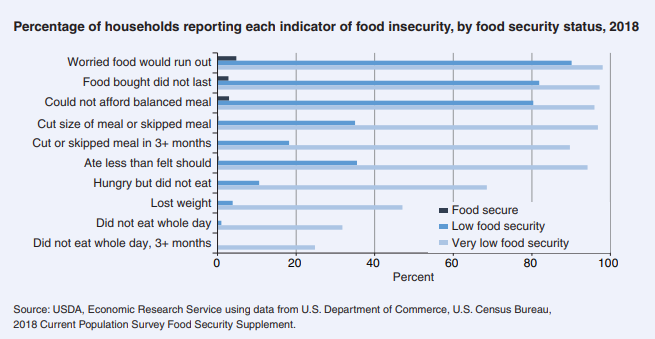
Food security should be easy for all Americans to achieve—right? Not so much. According to a USDA survey in 2018, ninety percent or more of individuals in the low food security and very low food security groups reported about worrying that the food they had would run out before accumulating enough money to buy more. This is compared to the less than ten percent of individuals in high or marginal food secure groups who reported the same indication.
What is the difference between food insecurity and hunger?
Food insecurity refers to the limited or fluctuating access to food dependent upon socioeconomic condition. Hunger refers to a physiological condition that may result as a consequence of food insecurity.
How does food security relate to race?
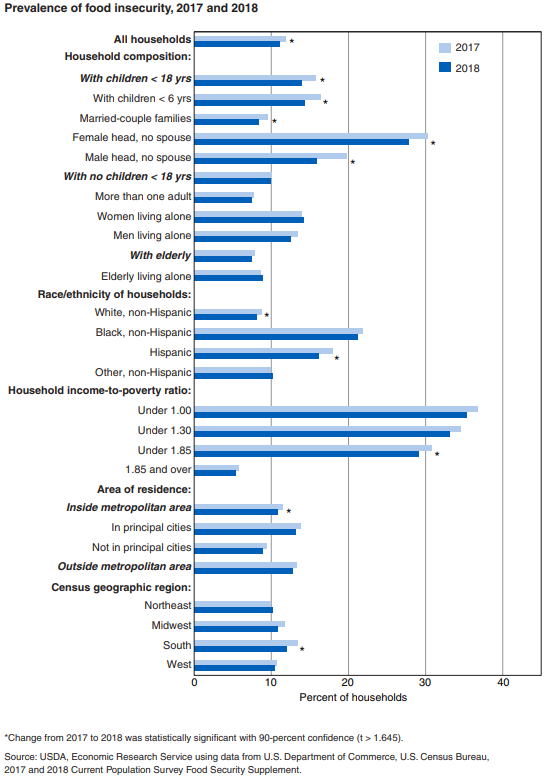
According to a USDA population survey in 2018, over twenty percent of Black households suffered from low to very low food insecurity. Over fifteen percent of Hispanic households also fell into this category. Compare these figures to the seven percent of White households with the same labels. The rates of food insecurity for Black and Hispanic households were much higher than the national average for single-parent households. Moreover, Black households are more than twice as likely than White households to experience hunger.
What is a “food desert?”
A food desert is an area with limited access to affordable, nutritious food. What does “limited access” mean? This could include the lack of a grocery store, lack of healthy options in food stores, and/or the lack of transportation to travel to the closest grocery store. Instead of healthy, fresh food options, individuals living in food deserts are subject to more processed foods that lack proper nutritional value. Currently, these food deserts tend to surround areas with higher Black and Hispanic populations. With poor nutrition follows poor health, thus disproportionately high rates of chronic disease in these minority communities come as no surprise.
This is more than just a “food issue”
When a household cannot afford the average cost of basic needs, one or more of those needs must be consciously put on the back burner. For instance, to prioritize having enough food in the house, one may have to forgo seeking care for health issues for fear of incurring high medical bills. This works the other way around. If rent is due, a household could prioritize housing costs over adequate nutrition. According to The Alliance to End Hunger, limited access to food stores correlates with high rates of chronic conditions, including diabetes and obesity.
Why are we talking about this?
Everything is intertwined. All of our basic needs are interrelated. And race? Race has everything to do with everything. Allowing the structural racism in society to persist today will result in continued health disparities, mortality, unemployment, and faults in the criminal justice system. We must take a holistic approach and tackle the root issues. As in medicine, treating symptoms is not sustainable. One way to address the root issue of food security—or lack thereof—is to adopt a human rights approach to develop sustainable strategies that advance racial equity within an intersectional framework.
Where to find more information and resources:
Imperfect Foods offers a Reduced Cost Box Program to households that cannot afford healthy food options and meet the low-income qualifications for SNAP. Moreover, during COVID-19, the company is offering free delivery to senior citizens aged 65 or older.
Food Empowerment Project annually publishes their “Shining a Light on the Valley of Heart’s Delight (PDF)” report that thoroughly highlights the issue of food access in certain local communities.
References
Definitions of Food Security. (2019). https://www.ers.usda.gov/topics/food-nutrition-assistance/food-security-in-the-us/definitions-of-food-security.aspx
Food insecurity rates are highest for single mother households and households with incomes below poverty line. (2018). https://www.ers.usda.gov/data-products/chart-gallery/gallery/chart-detail/?chartId=58384
Hunger is a racial equity issue. (2017). https://alliancetoendhunger.org/wp-content/uploads/2017/07/Hill-advocacy-fact-sheet__HUNGER-IS-A-RACIAL-EQUITY-ISSUE_Alliance-to-End-Hunger.pdf